Click to See My NEW Photography Blog:

Showing posts with label flowers. Show all posts

Monday, March 21, 2011

Pruning Hydrangeas

The key to knowing when and how to prune hydrangeas is knowing what type of hydrangea you have.

(Pee Gee hydrangea)

Pee Gees - can be pruned as early as January here in the south, but can also be pruned into March. Pee Gees bloom on "new" wood, meaning they haven't set their buds yet and won't be affected by a late frost.


Annabelles (Hydrangea Arborescens or Smooth Hydrangeas) - any time in February - March.

(Annabelle)

Both of the above can be pruned severely if you wish to keep them on the smaller side. Otherwise, they can all become quite big. Pruning severely = taking them down to 12 inches.

(mophead hydrangea)
Mopheads and Lacecaps - AFTER the LAST frost.(See special pruning instructions below.) I've pruned mine too early before and ended up doing the same job twice. Boo to late frosts!

(lacecap hydrangea)
In the south you are usually safe to prune around Mother's Day weekend.
Northeasterners should wait closer to Memorial Day weekend to prune.

Pruning Instructions for Mopheads & Lacecaps :
DO NOT prune severely. These hydrangeas bloom on "old" wood. Meaning their buds were setting back in September. The buds form on branches which were formed last summer. If you pruned them after September, you may be low on blooms this year.

If they have a bud or new growth at the tip of the branch, DO NOT cut it off.

(Unless it has been hit by frost and is brown. Like below)


If the new growth is a few inches down the branch, cut it about an inch above the bud or new growth. See below.
(Oakleaf Hydrangea)
Pruning Oakleafs:
Cut off spent flowers and do any pruning to shape the shrub or to control its size AFTER the flowers have bloomed. (July) If you live in a hot climate, the flowers will age and then brown out from the heat - so cutting them at this time improves the look of the plant anyway. Oakleafs also bloom on old wood and waiting too long to prune can decrease the blooms you get the following year.


General Pruning Tips:

When pruning, remove any dead wood from your shrub. Often these branches appear white, brittle and do not have any green in the branch even if you were to break it and look inside like I've done here. Cut these as close to the base of the plant as you can.You can remove up to one-third of a hydrangea, so if there are any branches that "bother" you, cut away!

Use sharp bypass shears when cutting hydrangeas. Thicker branches may require the larger, lopping shears.

('Endless Summer' Hydrangea)

If you are lucky enough to have an 'Endless Summer' mophead hydrangea, you can cut the blooms off by July 4th and should get a second bloom out of your shrub.

Well, if you're still reading, you're either my Ma-Ma or really into hydrangeas. Feel free to ask any hydrangea related questions in the comment area and if I don't know the answer, I'll try to find out.

Hope you have a bloom filled summer!
Thanks for visiting.

Wednesday, July 28, 2010

Hydrangeas Part II

You thought I forgot, didn't you? I did not. I lost my notes. I lost my mind. They have both returned. I began writing this post in my notebook, but found it became rather verbose. So if you can believe it, I'll have to write another post for Part III and the remaining questions I am often asked. This post addresses the question:
Is there a hydrangea I can grow even though we have harsh winters?
Why,yes, my cold weather friends there is...as long as you are in a region no lower than Zone 3 on a climate map. In case you are unsure of your zone, I've scanned a climate map below.(Click on map to enlarge)

Here is a breakdown for hydrangeas suitable for cold regions:

Zone 3: Hydrangea Paniculata AKA Pee Gee Hydrangeas

What they lack in color, they make up for with presence and abundance.Jackie-Baby and 'Limelight' blooms as big as his head
Bloom Color: Cream, ivory or white often aging to green or pink.
Pros: Blooms on new wood, so it is not affected by late frosts.

One of the few hydrangeas which does well in full sun - don't even think about putting her in the shade!
Fast grower and gets BIG! (I guess that's not a "Pro" if you have a small space.)
Bloom Time: Late summer, but blooms will age beautifully until hard frost.
Favorite Pee Gee: Limelight

Zone 4: Hydrangea Aborescens AKA Wild or Smooth Hydrangeas

A prolific and consistent bloomer. ( I have 6 of these beauties.)early 'Anabelle' hydrangea blooms
Bloom color: begins bright green, turns white and ages back to green.
Pros: Also blooms on new wood and is not affected by late frosts.
Can tolerate a little more sun. (But not full sun.)
Bloom time: Early in the season.

Favorite: Annabelle, which will re-bloom in late summer if deadheaded and cut back after the first bloom.

Zone 4: Hydrangea macrophylla 'Endless Summer' - mophead
The only mophead which can survive in the cold of Zone 4.'Endless Summer'
Bloom color: blue or pink depending on soil conditions.
Pros: very hardy and colorful!
Bloom time: June
The further north you are located, the more sun she'll tolerate. Here in the south, she'll need protection from the afternoon sun.

Zone 5: Hydrangea quercifolia AKA Oakleaf Hydrangea

As the name suggests, it's leaves look like those of an oak and color up beautifully in the late summer and fall. Oakleafs are are consistent and abundant bloomers which do well with sun, but not full sun. Needs good drainage. Some varieties get VERY big. Lulu by my neighbor, Pam's Oakleaf Hydrangea
Bloom color: Green to ivory/white and age pink. However, they will burn out or brown out by July here in the south. I simply cut the spent blooms & enjoy the remaining foliage.
Note: Bees love oakleaf blooms in the early stages, so beware if you are allergic to stings.
Favorite Oakleaf: 'Snowflake' - it has a double flower and the bloom ages better than others in my garden.
early blooming 'Snowflake' Oakleaf
'Snowflake' Oakleaf aging to pink

Zone 5: Hydrangea serrata AKA Lacecaps

Lacecaps have delicate, airy and dainty blooms and their leaves are narrow.'Purple Tiers'
Bloom colors: Purple, blue, white or pink.
Pros: Lacecaps are a more reliable bloomer than mopheads since they are hardier. (Less threatened by late frosts.) Since their blooms are more delicate, they remain upright.
Favorite Lacecaps: 'Purple Tiers', 'Tiara' and 'Blue Billow'
Note: Another favorite of bees once the centers "pop".'Tiara'
In case you are wondering why I am posting this now, it is because hydrangeas are best to plant in the fall. This way, there is less stress on the plant, it gets plenty of winter moisture and has time to set it's buds.
So go forth and get yourself a hydrangea or three...or five. Best to plant in odd numbers.
Thanks for visiting!


Wednesday, June 2, 2010

Hydrangeas - Part I

I have no idea how many parts this will result in because I am writing this as I type. Anybody else still like writing in notebooks or filling up tablets - then transfer it to the computer? No? Just a quirk I have cornered on the market? *Edited to add: I got kinda wordy and this is a long post - if you're not interested in learning about hydrangeas, you might just want to check out the pretty pictures. (Click on any picture to enlarge.)

Anyway, I began my love affair with hydrangeas when Mr. Sassypants and I moved into our home 13 years ago. My Ma-Ma sent me one as a housewarming gift and it is the stunner I still have at the bottom of our front porch steps. Um, I'm going to try and not gush on and on about the beauty of this plant...
(Merritt's Supreme Hydrangea)
Since I have an obscene number of these gems (50 total - 18 varieties and three "unknowns") and because I think I've been so fortunate to learn from some of the best hydrangea "experts", I want to share the knowledge I've gained from others and from my own experiences. Please take into account I am gardening in Zone 7, so my info translates well if you are in the Southeast. Mophead hydrangeas are the pickiest about their climates (in my opinion) and will do best if grown in Zones 6-9. (Tiara Hydrangea)
Requirements for healthy hydrangeas:

GOOD LIGHT

First, I'd like to address the issue of sun versus shade for hydrangeas. While they are known as a "shade" plant, they really should have SUN until about 1:00 or 2:00 pm. (Some types will tolerate a full day of sun and I'll tell more about them later.) The further north you are, the more they can tolerate more sun. If their leaves begin to scorch, they may be getting too much sun. Too little sun and you will end up with a green shrub and very few, if any, blooms. Say you have a mix of sun and shade...provided they get about 4 hours of direct light, you can grow a hydrangea.
(Limelight, PeeGee Hydrangea)
Say you have not a stitch of shade to be found on your property...you can still grow a hydrangea! Pick up a PeeGee hydrangea (known in hoighty-toighty garden circles as Hydrangea Paniculata). Best in zones 3-8. PeeGees are one of my VERY favorite varieties! They NEED full sun, can produce HUGE blooms (which dry exquisitely), are not affected by late frosts, can be pruned to tree form and bloom late in the summer when little else is happening in this southern garden! This is a picture from last summer. This was only it's second year in the ground and it reached about eight feet high. Be prepared to give this big girl some room! Oakleaf hydrangeas (Hydrangea Quercifolia, Zones 5-9) also will tolerate and do better with a little more sun.
(Oakleaf Hydrangea)
GOOD SOIL
Here in Georgia I've learned the hard way that amending my soil before planting is a required step - a huge pain in the tush, too! Given the hard clay we naturally have means adding and mixing in some bagged soil and compost. If you have gorgeous, dark, rich soil, I'm SO happy for you. (Dig into some hard clay and heave around some bags of cow manure and you'll realize I'm not being overly dramatic here.) Once your hydrangeas have been in the ground for a year, lay on a couple of inches of manure around the base of your plant. (Around March for Atlanta.)
(Penny Mac Hydrangea)
Sounds like a lot of work? The incredible, late Penny McHenry did this every spring and had over 300 hydrangeas. Penny was the founder of the American Hydrangea Society and a premier stop on the annual Hydrangea Tour here in Atlanta. Her garden was breathtaking and she was generous with her knowledge. Her garden is the reason I introduced Annabelles (a type of Hydrangea Arborescens, Zones 4-8) to my garden. This is also a variety which likes some more sun. (young Annabelle Hydrangea)
If you feel you must fertilize your hydrangea, you need only sprinkle some 10-10-10 at the base after the last freeze and when new green growth has pushed out. You can do the same again in June, but only if you're NOT in the middle of a drought! I've never fertilized my hydrangeas and never really felt the need for this step.

WATER
Of course all plants need water, but your hydrangea may need a little more in the first two years of its life, especially if you plant them in the early summer. The ideal (for the plant) time of year to plant a hydrangea is in the fall. (October for Atlanta) There is very little stress through our winters for a hydrangea. However, I know all the nurseries will have these gorgeous plants out now - my Ma-Ma gave me this one (below) while she was visiting - this Matilda Gutges, we both thought belonged in my garden.
Even when your hydrangea has been in the ground a few years, don't be surprised to see it go "limp" around 3:00pm. They will all do it (in the south especially).Here is one which has been in my garden for eight years now. The heat tends to bother it, but it will wake up refreshed the next morning. Of course, if your area is suffering from a drought, hydrangeas will become very stressed. Just try to get them water in the early morning at the base of the plant if possible.

I'll be back in a couple of days to answer FAQ's, so if you have any questions of your own, feel free to leave them in the comment section!
Thanks for visiting and Happy Gardening!

Monday, May 3, 2010

Fabulous Photoshop!

I have to admit that a lot of work (for me) goes into making a photograph. Before this whole digital world, I shot with a SLR and film - for twenty years. (Feel free to think, "Gee she must've started taking pictures when she was 10 years-old." I love starting the the day off in denial!) So shooting photos was a lot of trial and error. I got photos back and had to learn from my mistakes after the fact.

Now with my digital SLR and photoshop, I can go from this:(not too bad)
to this:
Our wonderful, cute, stinker-boy, Godson goes from this:
to this:

or even this:
Doesn't that make a world of difference?
So while it may take some extra time processing my own photographs, the time is well spent. I've had to learn to embrace this technical & digital world. It hasn't been the easiest transition, but how can I argue with the results?
I still believe though that even without this technology, anyone can become a better photographer by learning about the basics: lighting, composition, textures, patterns, etc. Do any of these topics interest you? Let me know!

If you have time, please visit Lens Us Together. I am hosting the theme this week and it is "Prepared". See what my peonies have to do with my theme!

As always, thank you for stopping by. Your kind comments and encouragement are greatly appreciated!

Sunday, April 25, 2010

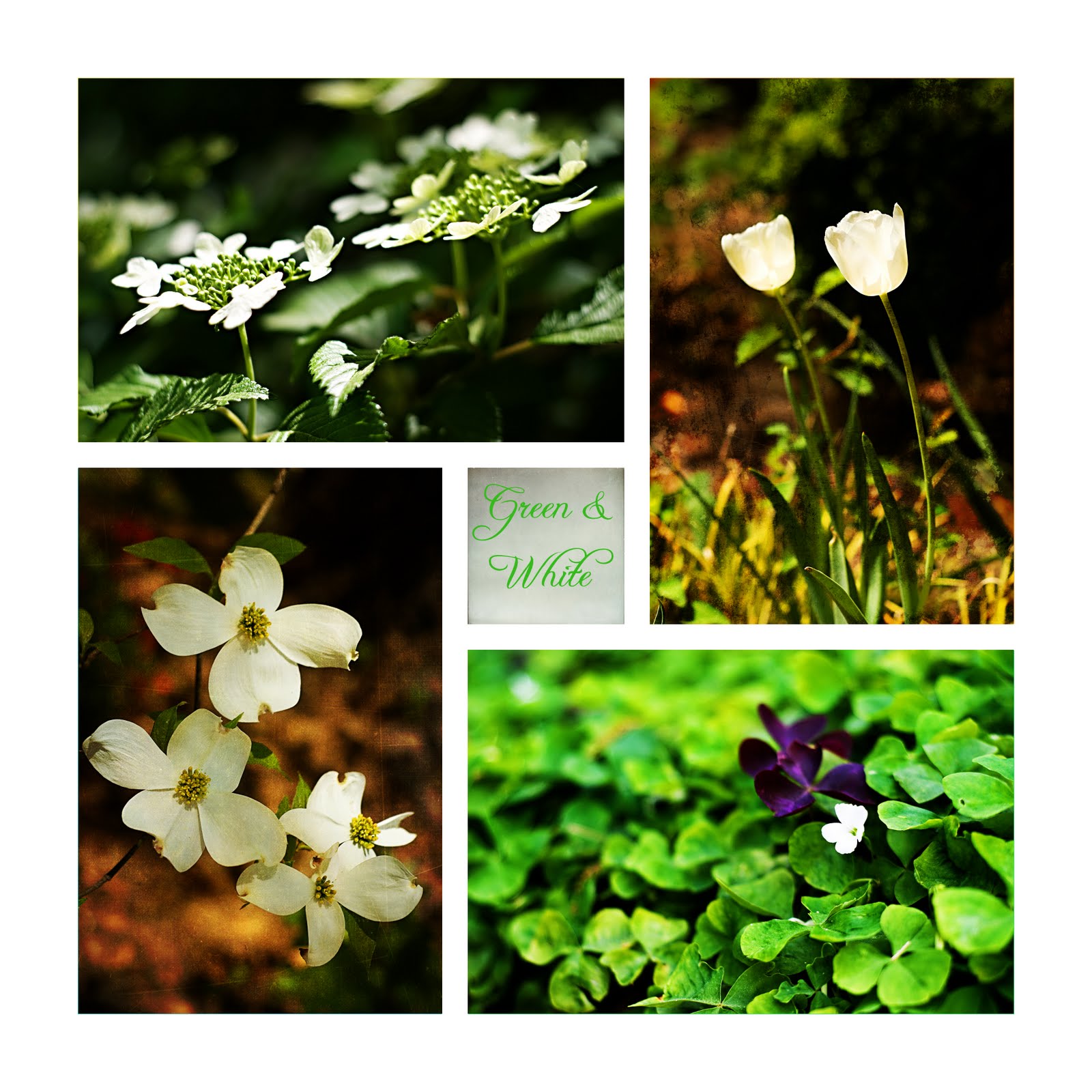
Green & White Mosaic

Taking part in Mary's Mosaic Monday again. Be sure to check out the other fab mosaics via her Mr. Linky.
The viburnum and clover are mine, the tulips and dogwood courtesy of my neighbor, Caroline.
Thanks for stopping by and taking a peek!

Tuesday, April 20, 2010

I Can Tell It's Spring...

my house is dustier than usual,
the kids beg to be outside every day after school and
the only thing my neighbors have seen of me is my fanny
due to weeding and mulch-spreading.
And then there's this:

I planted these Lily of the Valley plants years ago.
This is the first year one has bloomed.

My new blog is more for my photography and less blabbing.
You can click here or at the top of this blog there is a link.
(But don't Google Traci Lord - that's a whole other kind of photography!)

Happy Spring, blogging friends!

Friday, March 5, 2010

Something Different

Sorry for my lengthy absence from posting here...I start feeling really bad when my good friend, Bethany has managed three posts for March, by March 4th and she has four children! I haven't posted since February. Oh fudge.

I have been productive though! I spent a good bit of time moving furniture in preparation for...having painting done and having a board & batten treatment done to our bedroom. So of course, I also spent two days removing wallpaper. (If I ever speak of having wallpaper put up in our home, somebody please promise me you will walk, run, drive or fly to my house, ring my doorbell and smack me upside my head.) I will take you to lunch or dinner and thank you profusely when I come to my senses. Jeez. What was I thinking? Obviously, I had never had to remove wallpaper before I'd gone through my wallpaper phase! Anyway, I will be sure to post some before and after shots when the work is done - which is soon.

In the meantime, I leave you with this:
Camillas from our back yard.
Photograph enhanced with photoshop and textures. Very fun to do!
(Much more fun than removing wallpaper!) What isn't?
Happy Friday, friends!